


Huawei Wins Smartphones Race in China During March 2015

In the first quarter of 2015, Huawei has successfully raised its market share in the Chinese market. This was recently stated by GFK – a company engaged in authentic research surveys on the Chinese smart-phones retail market. Its latest report shows data, as of March 2015, where the market-share of the top three domestic smartphones, namely; Huawei, Apple and Samsung were discussed.
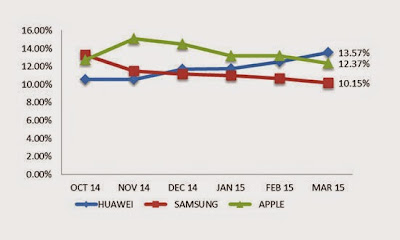
Huawei has now occupied the top spot in China for the first time, while the market shares of the other two competitors are showing a consistent decline in the Chinese market since November 2014. Whereby, Samsung’s market share dropped to third during March 2015.
Huawei accounted for 33% of the market-share. According to a recent Data disclosure of Huawei; More than 4 million units of Huawei Mate 7 flagship model were shipped over the past six months. This is a new world-record in the domestic, high-priced smart phone shipments. The GFK statistical data, on the Chinese market in March, reflects that Huawei achieved a sales value of 6.535 billion yuan indicating the remarkable progress of Huawei in the Chinese market. The total market size of smart-phones in China during the first quarter of 2015 was 99 million dollars.

Huawei Reveals its New Tablet Huawei MediaPad M2

We have got a new entry in the world of tablets by Huawei. Huawei has revealed its new tablet Huawei MediaPad M2 in France and will hit the shelves soon. The MediaPad M2has some outer look likeliness to its predecessor M1 but unleashed itself with some greater specifications as compared to M1 which was revealed at MWC last year.
Having a weight of only 310g with a thickness of 7.8mm, MediaPad M2 is not the slimmest tablet on the planet but still leaves space for the muscular tablets around. The slate comes with 8 inch Full HD display and a 2GHz 64-bit Octa-Core Kirin 930processor. This time Huawei gives a boosting shot to its RAM, the tablet has a 2 GB RAMand internal memory of 16 GB while the external memory can be extended through microSD Card (external memory not specified yet). Furthermore the tablet comes with 8 MP rear camera with LED Flash while the front camera consists of 2 MP. The MediaPad M2 is powered by a long lasting battery of 4800mAh.
The M2 runs on Android Lollipop 5.0 with Huawei’s Emotion UI 3.1 software coatand is expected to be available for sale early June. Tablet comes with two models the Wi-Fi model and LTE model. The Wi-Fi model starts around $310 while the LTE compatible model will be priced around $390.
Market Shares of Leading Operating Systems Released

Android and iOS are the common Operating Systems used mainly these days. Android, which is Linux-based is partly1 open source and generally more customizable whereas iOShas uniform design elements. Apple was the first to introduce the iPhone. It flagged the way for smartphones and shortly Google went on to launch the Android mobile operating system. Ever since, both mobile phone platforms are in direct competition and trying to leave each other behind. Considering on whom you’re asking or what aspects you’re looking at, both the Android and iOS knock down each other in different categories and in different constituencies.
It all depends on user choice, Android fans would say Android is the best and vice versa, but it’s not the real truth. In some countries of Europe, Android is still on the top with a68.4% share of the market but iOS saw a small growth of about 20.3%.
According to Kantar Worldpanel’s ComTech, iOS is gaining more popularity in Spain, Italy, Germany, France, and UK. The number may be far from Android’s (about a third) but Google’s mobile platform share decreased by 3.1% points. Unexpectedly, Windows Phone gain 1.8 points, same as Apple’s iOS. These numbers are only for the first quarter of 2015 and are being compared to last year’s first quarter.
| EU5 | 3 m/e MAR 2014 | 3 m/e MAR 2015 | % pt. Change |
| Android | 71.5 | 68.4 | -3.1 |
| iOS | 18.6 | 20.3 | 1.7 |
| Windows | 8.1 | 9.9 | 1.8 |
| Other | 1.8 | 1.4 | -0.4 |
While, in Chinese market, iOS is also making its mark. In a time period of only one year, iOS shares are rapidly spreading. From 17.9% share last year, iOS is now at 26.1%. The credit of this success can be given to the iPhone 6 and iPhone 6 Plus. While Android’sshare decreased by 8 percent, last quarter was 72% whereas, the share in first quarter of 2014 was 80%.
| CHINA | 3 m/e MAR 2014 | 3 m/e MAR 2015 | % pt. Change |
| Android | 80.0 | 72.0 | -8.0 |
| iOS | 17.9 | 26.1 | 9.2 |
| Windows | 1.2 | 1.2 | 0 |
| Other | 0.9 | 0.7 | -0.2 |
However in Japan and France we saw some decrease in Apple iOS share by a few points only. Windows Phone gained 5.8% share in France while Android and iOS both loose some points.
From all this comparison across different regions, we can assume that Apple is snatching some noteworthy points from Android. It looks like Android is getting away from its path while the iOS numbers are growing.
Huawei Figures out the Smart City Vision

Talking to the Broadband Asia, Huawei figures out the Smart City Vision by claiming that the world is just at the initial phase of the journey to smart cities, with enormously information being collected but not used very effectively because the vertical markets are not yet connected due to which the transformation and sharing of information is lacking.
John Frieslaar Huawei’s Director of Strategy and Innovation said that:
“A smart city is a journey that goes from connected cities, to smart cities to intelligent cities, which ultimately will be more sustainable. The journey is all about how you use the data, moving from using data to understanding what happened, to using it to change the future.”
To make it happen to smart cities it’s not about connecting people or making broadband access and availability easy, it’s only about transformation of information. How we gain and access the information and how we transform it, how we pass it to other people with in our community and what do we do with that information. The use of information for the welfare of the community is the most important aspect of the smart cities.
For smart cities, smart services are necessary as many of the city councils are doing great and innovative things which in return force the telecom community to pay attention to the shifts with in the community and figure out the new types of services that are required from the networks.
Trends like autonomous vehicles, the Internet of Things (IoT), cloud computingand 3D printing is impacting the way networks are developed and deployed.
Frieslaar also said that:
“The broadband architecture for 2020 will be built on a number of major components such as 5G radio access, software defined networks that allow the granular switching of traffic flows, network function visualization and storing things in the cloud.”
The core objective behind all this is the call to accelerate business through faster network, innovation cycles and more rapid development of new services. Smart cities are becoming a major driver for today’s businesses and their growth, for this reason networks and services must also be faster to cope up with the shift.
Subscribe to:
Posts (Atom)


